
Time to share my empirical work and methodology - not just theory. My empirical study draws on Ukrainian wartime diaries published since Russia’s full-scale invasion of Ukraine. The body of such literature is striking: more than 350 volumes - and the still growing. Yet this precious material has almost never become the subject of systematic qualitative research. Interviews, oral histories, social network posts - all this is studied abundantly. But not published narratives.
Of course, not all books positioned as diaries represent the experience of staying in disrupted homelands that I pursue. Not even all passages in the same book. For example, I excluded passages focused on evacuation, refugee experience, frontline military service, or life abroad.
But the main difficulty lies elsewhere. As literary texts, diaries are written in multiple languages, across diverse regions, with different temporal structures and highly contextual vocabularies. Managing this extremely rich yet extremely heterogeneous data that stubbornly resists any standardization is a real challenge.
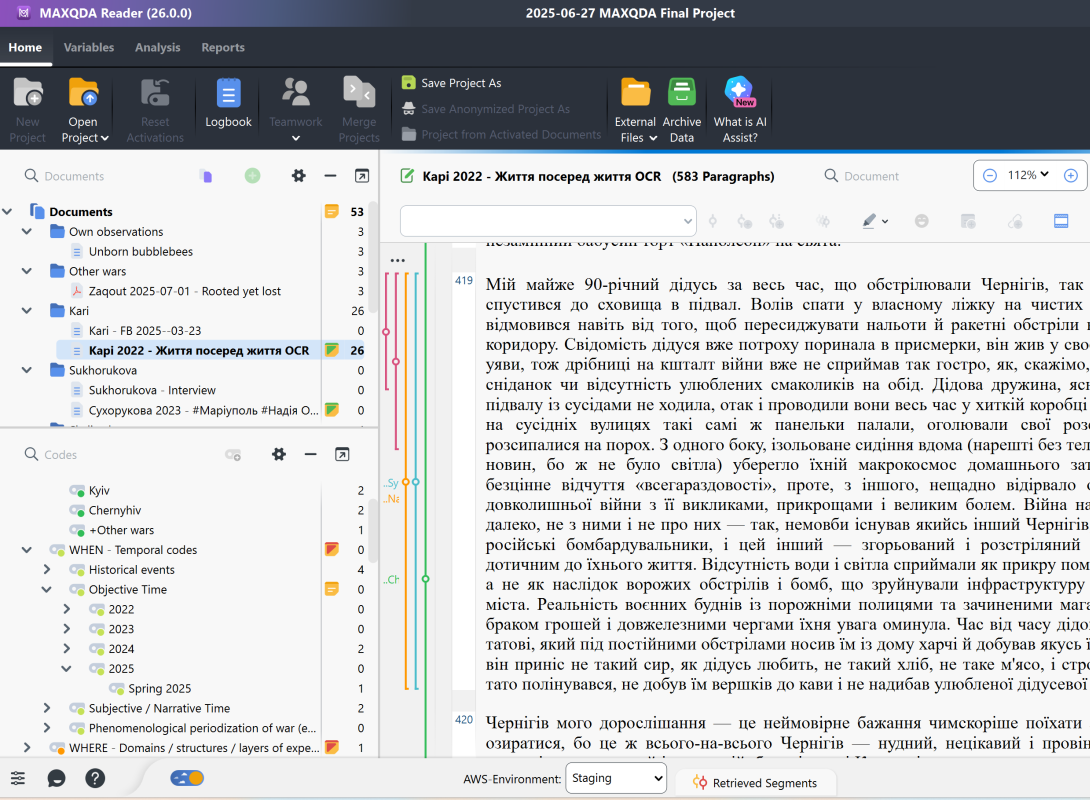
This is the issue I attempt to address in the first methodological preprint developed within a MAXQDA course at the Graduate School for Social Research. It’s more a methodological documentation than a polished analysis. Yet I hope it may prove helpful to those working with testimonies from the Russian war against Ukraine - as well as to researchers working with multilingual, structurally diverse, and complex data more broadly.
By the way, it also presents early findings on what I call "ambivalent normality" – how everyday life paradoxically continues (and even intensifies) under war conditions.
The report is here: https://doi.org/10.5281/zenodo.18040135
- Log in to post comments